

Buying plastic buckets may look simple at first. Many buyers only compare capacity, price, and color. However, for B2B packaging projects, the wrong bucket can cause serious problems: inaccurate filling volume, leakage, product contamination, broken handles, poor stacking performance, customer complaints, and higher replacement costs.
Whether you are buying packaging for food ingredients, sauces, powders, chemicals, coatings, adhesives, cleaning products, lubricants, pet food, or industrial materials, the plastic bucket must match your product, filling method, sealing requirement, logistics route, and target market.
This guide explains five common mistakes buyers make when purchasing plastic buckets — and how to avoid them before placing a bulk order.
At JM Packaging, we provide a wide range of plastic buckets and pails for food, chemical, paint, industrial, agricultural, and export packaging applications.
Quick Buying Checklist for Plastic Buckets
Before choosing a plastic bucket supplier, confirm these key points:
| Buying Factor | What to Check | Why It Matters |
|---|---|---|
| Capacity | Nominal capacity, actual filling volume, overflow volume | Prevents underfilling, overfilling, and customer disputes |
| Material | PP, HDPE, food-grade material, virgin or recycled material | Affects safety, durability, chemical resistance, and compliance |
| Lid & sealing | Snap-on lid, screw lid, gasket, tamper-evident lid | Reduces leakage, contamination, and product loss |
| Application | Food, chemical, paint, powder, liquid, paste, pet food | Different products need different bucket structures |
| Wall thickness | Bucket strength, impact resistance, load capacity | Affects durability during filling, stacking, and shipping |
| Handle | Plastic handle or metal handle | Affects carrying strength and user experience |
| Stacking | Empty stacking, filled stacking, pallet loading | Improves warehouse and export logistics efficiency |
| Customization | Color, logo printing, labeling, IML, heat transfer | Supports brand presentation and product differentiation |
| Supplier capability | Factory experience, quality control, samples, export support | Reduces sourcing risk and communication problems |
Mistake 1: Trusting the Labeled Capacity Without Checking Real Filling Volume
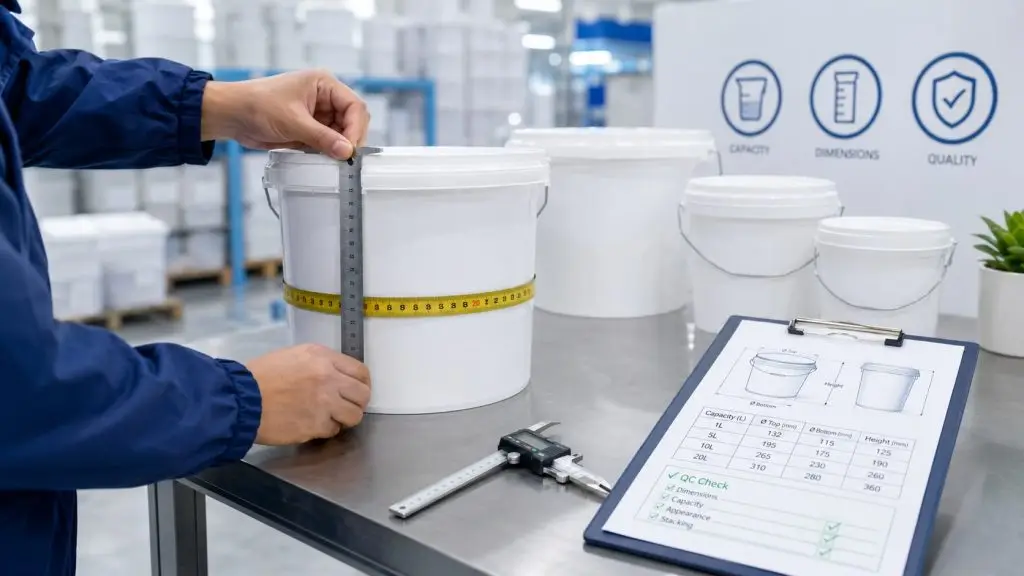
One of the most common mistakes is assuming that the labeled bucket capacity is always the actual working volume.
For example, a bucket marked as 20L may not be suitable for filling exactly 20L of liquid if the product needs headspace, sealing clearance, foam control, or shipping stability. Some buyers also confuse nominal capacity, brimful capacity, and safe filling capacity.
This problem is especially important for:
- Food sauces and condiments
- Paint and coatings
- Chemical liquids
- Cleaning products
- Powders and granules
- Pet food and dry ingredients
- Export packaging projects
How to Avoid This Mistake
Ask the supplier for detailed specifications before ordering:
- Top diameter
- Bottom diameter
- Height
- Nominal capacity
- Recommended filling volume
- Lid type
- Material
- Weight
- Packing quantity
- Pallet loading plan
For example, JM Packaging’s 2 Gallon Food Grade Plastic Bucket with Lid provides size, material, capacity, lid, handle, printing, and application information, making it easier for B2B buyers to evaluate whether the bucket matches their filling and distribution needs.
Buyer Tip
For liquid products, do not only ask, “How many liters is this bucket?”
Ask instead:
“What is the recommended filling volume for my product type and sealing method?”
This helps avoid leakage, deformation, and transport problems after filling.
Mistake 2: Choosing the Wrong Material for the Product
Not all plastic buckets are suitable for all products.
The most common plastic bucket materials include:
| Material | Common Use | Main Advantages | Buyer Notes |
|---|---|---|---|
| PP | Food packaging, industrial packaging, paint pails | Good rigidity, heat resistance, clean appearance | Common choice for many packaging buckets |
| HDPE | Chemical packaging, liquids, industrial storage | Good toughness and chemical resistance | Suitable for many liquid and chemical products |
| Food-grade plastic | Food ingredients, sauces, condiments, powders | Designed for food-related applications | Ask for material and compliance documents |
| Recycled plastic | Non-food industrial uses | Cost-effective and more sustainable in some cases | Not suitable for all food-contact applications |
Food-contact packaging should be evaluated carefully. The FDA regulates substances that come into contact with food, including packaging materials and containers. In the EU, food contact materials are also covered under a harmonized legal framework for safety and inertness.
Reference links:
How to Avoid This Mistake
Match the material to your product:
- For food ingredients, sauces, snacks, powders, grains, pet food, and seasonings, consider food grade plastic buckets.
- For coatings, adhesives, cleaning products, lubricants, and industrial liquids, consider industrial-grade plastic pails with lids.
- For products requiring added safety and quality protection during storage or shipment, consider tamper-evident plastic pails.
Buyer Tip
Do not only ask whether the bucket is “good quality.”
Ask:
“Is this material suitable for my product, filling temperature, storage time, and target market?”
Mistake 3: Ignoring Lid Design and Sealing Performance
A plastic bucket is only as reliable as its lid.
Many packaging failures come from poor lid matching, weak closure design, missing gasket, unsuitable sealing structure, or using the wrong lid for the product. A bucket may look strong, but if the lid does not seal well, the product may leak, absorb moisture, dry out, become contaminated, or lose shelf life.
This is especially critical for:
- Paint and coatings
- Adhesives and sealants
- Sauces and condiments
- Cleaning products
- Chemical liquids
- Food powders
- Pet food and dry goods
- Agricultural products
Common Lid Options
| Lid Type | Suitable For | Key Benefit |
|---|---|---|
| Standard snap-on lid | Dry goods, powders, general storage | Simple and cost-effective |
| Lid with gasket | Liquids, sauces, wet products | Better sealing performance |
| Screw-top lid | Powders, reusable storage, repeated opening | Convenient opening and closing |
| Tamper-evident lid | Food, chemical, high-value goods, export products | Helps show whether the package has been opened |
| Vent lid | Certain chemical or fermentation-related uses | Helps manage pressure under specific conditions |
For products that require product safety, freshness, and quality assurance during storage or shipment, a 5 Gallon Plastic Pail with Tamper Evident Lid can be a strong option.
How to Avoid This Mistake
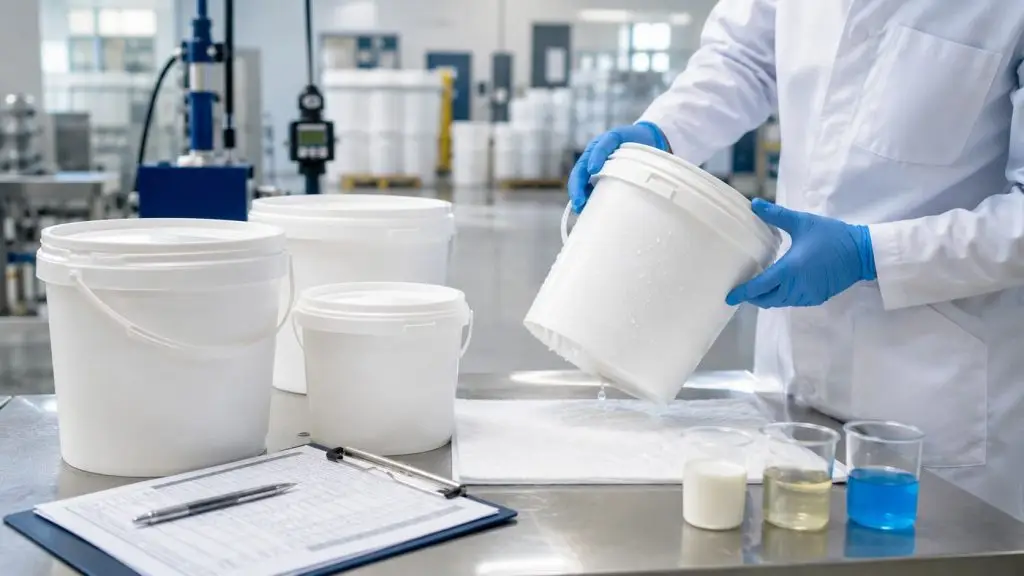
Before confirming a bulk order, request samples and test the closure system:
- Fill the bucket with your actual product or a similar test liquid
- Close the lid using the same method as production
- Turn, tilt, and transport the sample
- Test stacking and pallet movement
- Check leakage after vibration or handling
- Confirm whether workers can open and close the lid efficiently
ASTM also lists packaging standards related to leakage testing of empty rigid containers, which shows that leak performance is a recognized packaging evaluation issue.
Reference link: ASTM Packaging Standards
Buyer Tip
Do not buy the bucket and lid as separate decisions.
Evaluate them as one complete packaging system.
Mistake 4: Choosing the Cheapest Bucket Instead of the Lowest Total Cost
A low unit price can be attractive, especially for bulk purchasing. But the cheapest plastic bucket is not always the most cost-effective choice.
Low-cost buckets may have:
- Thin walls
- Weak handles
- Poor lid fit
- Inconsistent dimensions
- Lower impact resistance
- Poor stacking performance
- Higher breakage rate
- More leakage complaints
- Shorter service life
For B2B buyers, the real cost is not just the bucket price.
Total Cost of Ownership
| Cost Factor | Cheap Bucket Risk | Better Bucket Advantage |
|---|---|---|
| Product damage | Higher leakage or breakage risk | Better protection |
| Labor cost | More handling problems | Easier filling, carrying, and stacking |
| Replacement cost | More rejected or broken buckets | Longer usable life |
| Customer complaints | Higher after-sales risk | More stable customer experience |
| Logistics cost | Poor stacking and pallet loading | Better warehouse and shipping efficiency |
| Brand image | Poor packaging appearance | Better retail or industrial presentation |
For industrial products, an 18L Plastic Bucket with Handle can provide a practical balance between capacity, carrying convenience, and storage performance. For larger filling needs, a 5 Gallon / 20L Plastic Pail with Lid can support paint, coatings, chemicals, adhesives, lubricants, cleaning products, and other industrial packaging applications.
How to Avoid This Mistake
Compare buckets based on application value, not only unit price.
Ask your supplier:
- What is the bucket weight?
- What material is used?
- What is the lid matching method?
- Can it be stacked after filling?
- What handle options are available?
- Can it pass transport and warehouse handling?
- Is it suitable for pallet loading and export shipment?
- Can it support logo printing or labeling?
Buyer Tip
The best plastic bucket is not always the cheapest one.
It is the one that protects your product, reduces handling problems, and supports your supply chain.
Mistake 5: Buying from a Supplier Without Clear Specifications or Export Support
A plastic bucket supplier should do more than quote a price.
For B2B packaging buyers, especially importers, distributors, food factories, chemical companies, and private label brands, supplier reliability is critical. A weak supplier can cause inaccurate specifications, poor quality consistency, delayed delivery, unclear communication, and packaging that does not match the final application.
Signs of an Unreliable Supplier
| Warning Sign | Possible Risk |
|---|---|
| Only provides price, no specification sheet | Hard to confirm product fit |
| Cannot provide sample before bulk order | Higher risk of mismatch |
| No clear material information | Safety and compliance concerns |
| Limited lid options | Sealing may not match product |
| Poor communication | Delays and order errors |
| No customization support | Hard to build brand packaging |
| No export packing plan | Higher damage risk during shipment |
How to Avoid This Mistake
Choose a supplier that can support your full packaging decision, including:
- Product recommendation
- Capacity selection
- Material selection
- Lid matching
- Handle choice
- Printing method
- Labeling
- Packing method
- Pallet loading
- Export shipment support
JM Packaging supports custom bucket color, logo printing, labeling, lid matching, handle options, carton packing, bulk packing, and export packaging support across different plastic bucket products.
For buyers who need a broader packaging plan, JM Packaging also provides plastic food containers, plastic jars and bottles, and one-stop packaging solutions for food, chemical, and logistics applications.
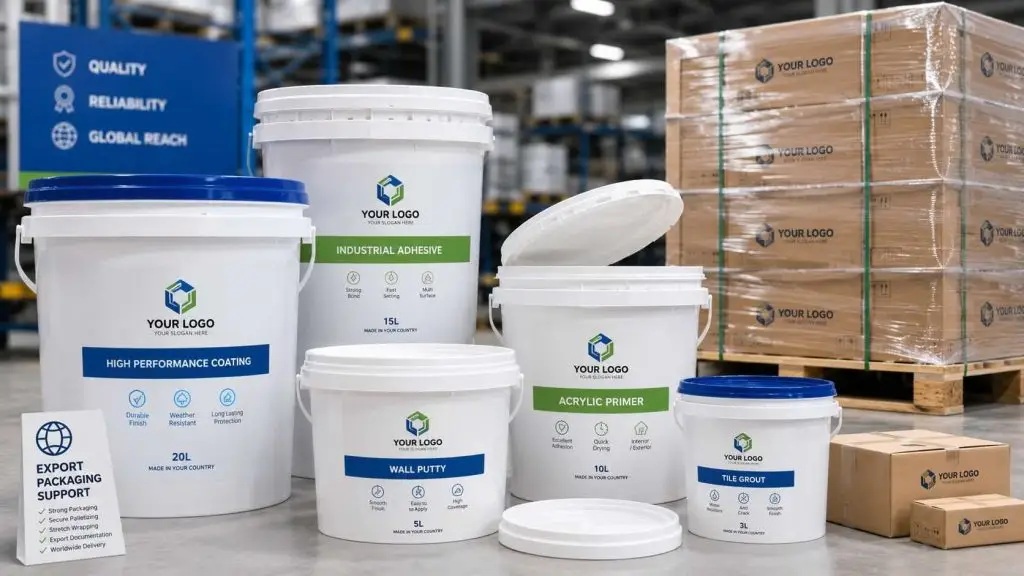
Custom plastic buckets with logo printing labeling lid options and export packaging support
Plastic Bucket Selection by Application
Different products need different bucket structures. Use this table as a starting point.
| Application | Recommended Bucket Type | Important Features |
|---|---|---|
| Food ingredients | Food grade plastic bucket | Food-contact material, secure lid, clean appearance |
| Sauces and condiments | Food grade bucket with reliable lid | Leak resistance, easy handling, label space |
| Pet food and snacks | Food bucket or plastic jar | Moisture protection, resealability, brand label |
| Paint and coatings | 5 gallon / 20L plastic pail | Strong body, lid sealing, handle, stacking |
| Chemicals | Industrial plastic pail | Material compatibility, lid strength, export packing |
| Adhesives and sealants | Heavy-duty plastic pail | Impact resistance, secure lid, stable storage |
| Powders and granules | Bucket with lid or screw-top container | Moisture protection, easy opening, clean storage |
| Agricultural products | Plastic bucket with handle | Durable body, easy carrying, warehouse efficiency |
| Retail packaging | Custom printed bucket or jar | Branding, color, label, logo printing |
Product Recommendations from JM Packaging
For Food, Sauces, Powders and Pet Food
Choose the 2 Gallon Food Grade Plastic Bucket with Lid for food ingredients, sauces, condiments, powders, grains, snacks, pet food, bakery supply, restaurant storage, retail packaging, and wholesale food packaging.
For Paint, Coatings and Industrial Liquids
Choose the 5 Gallon / 20L Plastic Pail with Lid for paint, coatings, chemicals, adhesives, lubricants, cleaning products, construction materials, and industrial liquid packaging.
For Products Requiring Extra Safety Protection
Choose the 5 Gallon Plastic Pail with Tamper Evident Lid for products that need secure storage, filling, transportation, and visible protection against unauthorized opening.
For Medium-Volume Industrial Packaging
Choose the 18L Plastic Bucket with Handle for chemicals, coatings, adhesives, cleaning products, lubricants, powders, granular materials, agricultural products, and general industrial packaging.
For More Plastic Bucket Options
Explore the full Plastic Buckets & Pails category to compare different capacities, shapes, lids, handles, printing methods, and application options.
Final Buyer Checklist Before Placing a Bulk Order
Before confirming your plastic bucket purchase, make sure you can answer these questions:
- What product will be filled into the bucket?
- Is the product liquid, powder, paste, granule, or solid?
- Is food-contact material required?
- What is the target filling volume?
- Does the bucket need a standard lid, gasket lid, screw lid, or tamper-evident lid?
- Will the bucket be used for storage, retail, export, or industrial transport?
- Does it need to be stacked after filling?
- What handle strength is required?
- Does the product need logo printing, labeling, or IML decoration?
- What is the destination market and shipment method?
- Do you need carton packing, pallet packing, or bulk packing?
- Has a sample been tested before mass production?
Conclusion: The Right Plastic Bucket Protects More Than the Product
Buying plastic buckets is not just a price comparison. A reliable bucket protects your product, reduces leakage risk, improves handling efficiency, supports your brand image, and helps your supply chain run more smoothly.
The five mistakes to avoid are:
- Trusting capacity claims without checking real filling volume
- Choosing the wrong material
- Ignoring lid and sealing performance
- Prioritizing low price over durability
- Buying from a supplier without clear specifications or export support
At JM Packaging, we help B2B buyers choose suitable plastic buckets and pails according to product type, capacity, material, lid requirement, printing method, packing method, and export destination.
Looking for reliable plastic buckets for food, chemical, paint, industrial, or export packaging?
Contact JM Packaging to discuss your product, order quantity, customization needs, and packaging solution.
FAQ
1. What is the best plastic bucket material for food packaging?
Food-related products should use food-grade plastic materials suitable for the intended application. Common options include food-grade PP or HDPE, depending on the product type, filling condition, and target market.
2. What size plastic bucket is best for industrial packaging?
For industrial packaging, 18L and 20L plastic buckets are common choices because they provide enough volume for bulk filling while remaining convenient for handling, stacking, and transportation.
3. What is a tamper-evident plastic pail used for?
A tamper-evident plastic pail is used when the product needs visible protection against unauthorized opening. It is suitable for food ingredients, chemicals, coatings, agricultural products, and other goods that require safety and quality assurance during storage or shipment.
4. Can plastic buckets be customized with logo printing?
Yes. Plastic buckets can be customized with color, logo printing, labeling, heat transfer printing, screen printing, or IML depending on the bucket type and order quantity.
5. How do I choose the right plastic bucket supplier?
Choose a supplier that can provide detailed specifications, material information, lid options, sample testing, customization support, stable quality control, and export packaging assistance.