
What is the first physical interaction a customer has with a packaged food product?
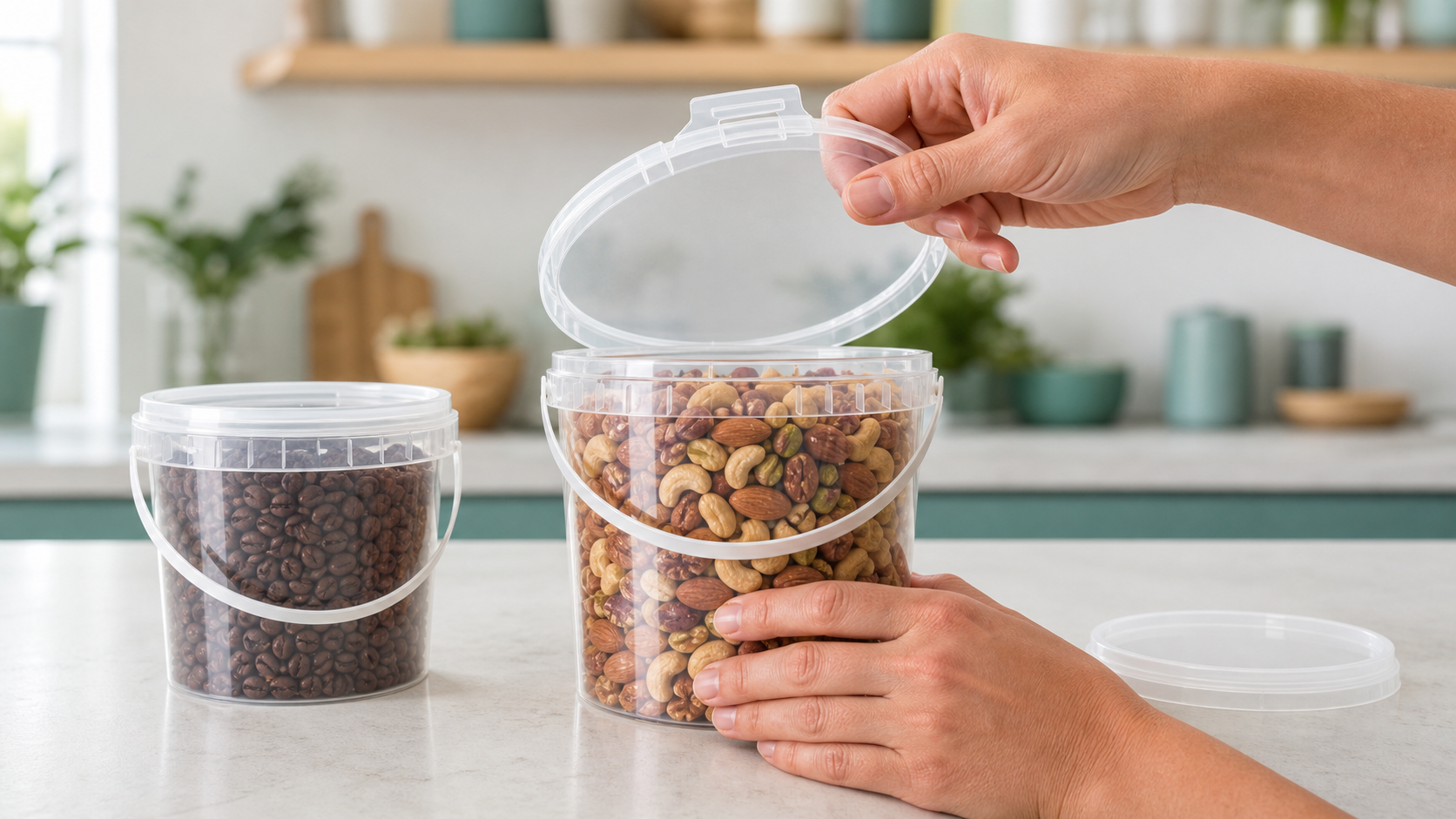
It is often not reading the ingredient panel or studying the graphics. It is opening the package.
That action may take only a few seconds, but it can shape the customer’s first practical impression of the product. A lid that is extremely difficult to remove creates frustration. A lid that feels loose may create doubts about package integrity. An unclear opening point can make a well-designed package feel confusing. And if the container is difficult to close again, every later use repeats the same inconvenience.
For food brands, the opening experience is not a minor detail. It is part of product quality, usability and brand perception. This guide explains how opening force, tamper evidence, lid fit and reclosure work together in food-grade PP bucket packaging and how JM Pack helps buyers test them before production.
Packaging Experience Begins After the Purchase
Packaging development often focuses heavily on what happens before the sale:
- Does the product stand out on the shelf?
- Does it look good in an e-commerce image?
- Is the brand logo easy to recognize?
- Does the container communicate the right product information?
All of these questions matter. But after the customer takes the product home, the priorities change. The customer now cares about whether the package is easy to carry, easy to open, comfortable to use and simple to close again.
This is especially important for foods that are consumed over several occasions, including nuts, coffee beans, tea, candy, bakery ingredients and pet treats. The user may repeat the same cycle every day:
- Open the package.
- Take out a portion.
- Close the package again.
The package is no longer only a sales display. It becomes a tool throughout the product’s use cycle.
Why “Difficult to Open” Is a Real Packaging Problem
Food packaging needs an appropriate closure, but stronger is not always better if strength is achieved at the expense of usability.
When opening force is excessive, consumers may struggle to find leverage, apply uneven force or reach for scissors and other tools. That increases frustration and may also create an uncontrolled opening in which the lid releases suddenly or the product spills.
Customers rarely interpret this as “excellent sealing.” Their immediate reaction is more likely to be, “Why is this so hard to open?”
The correct opening force depends on the container, lid, product, filling process and distribution requirements. The goal is a balanced closure that remains secure through normal handling but can still be opened in the intended way by the target user.
This balance should be tested, not assumed from a drawing or an empty-package specification.
A Loose Lid Can Damage Confidence Just as Quickly
At the other extreme, a lid that closes with little feedback or moves too easily can make the customer question whether the package has been protected.
Even when the food itself is unaffected, uncertainty changes the experience. Consumers may wonder whether the package was fully closed, whether it opened during shipping or whether it can protect the remaining product after first use.
Good lid fit gives the user clear physical feedback. The lid aligns with the bucket rim, closes consistently and feels stable after application. The package should also reopen and reclose in a predictable way when repeated access is part of the intended use.
The bucket and lid therefore need to be evaluated as one packaging system. Selecting a rigid container without testing its matching closure misses one of the most important points of consumer interaction.
Tamper Evidence Makes the First Opening More Intuitive
For many food products, customers want a visible indication of whether a package may have been opened before purchase.
A tamper-evident or tamper-indicating closure can make the first-opening state easier to understand. Depending on the design, a band, tab or connected feature changes when the package is opened for the first time. The customer can inspect the feature before use and recognize that the package state changes after opening.
This does not replace a complete food-safety and distribution assessment, and the correct tamper solution depends on the product and market. But a clear first-opening feature can improve confidence and reduce uncertainty.
The opening point should also be easy to identify. If the user cannot understand where to begin, the value of the feature is reduced. Molded geometry, an opening tab and visual design can work together to guide the intended action.
Sealing Performance and Opening Convenience Must Be Balanced
It is tempting to treat sealing and easy opening as opposites. In practice, a well-designed food package considers both.
The closure should support the product’s handling and storage requirements while keeping the consumer interaction reasonable. Important factors can include:
- Bucket rim geometry.
- Lid groove and engagement design.
- Material stiffness and flexibility.
- Manufacturing dimensional control.
- Closing equipment or manual closing method.
- Filling temperature and process conditions.
- Distribution, stacking and transport conditions.
- Expected number of opening and reclosure cycles.
Changing only one factor can affect the entire experience. For example, increasing closure engagement may change opening force. A different resin or geometry may change how the lid flexes. This is why sample testing with the actual product and process is essential.
Reclosure Matters for Foods Used Over Several Days
The first opening receives the most attention, but the second, third and tenth closures may matter even more in daily life.
After taking a portion, the customer should be able to place the lid back on the bucket without a complicated procedure. The lid should align easily, close with understandable feedback and remain practical after repeated use.
Reclosure supports convenience for products such as:
- Nuts and dried fruit eaten as snacks.
- Coffee beans measured each morning.
- Tea leaves used over many servings.
- Candy and cookies shared over time.
- Pet treats opened several times per day.
- Bakery ingredients used in a commercial kitchen.
For these applications, a reclosable food-grade PP bucket can add value beyond product containment. The package becomes part of the customer’s storage and portioning routine.
Brands should still evaluate the barrier and shelf-life needs of the actual food. A reclosable lid can improve handling convenience, but it should not be treated as a universal substitute for any inner seal or barrier system required by the product.
Opening Size Affects Product Access
Opening experience is not only about removing the lid. The bucket opening must also work with the product and the way it is taken out.
A wide opening may make it easier to scoop ingredients, remove fragile pieces or see the remaining contents. For products with large particles, a narrow opening can make dispensing awkward. For powders or small granules, the relationship between opening size, scoop size and portion control may be more important.
The customer should not need to tip a large bucket at an uncomfortable angle or reach through an opening that is too small for the intended use. Product access should be included in the sample test alongside lid performance.
Transparent PP Buckets Can Improve the Use Experience
Transparent food buckets allow users to see product color, particle size and remaining quantity. This can make selection easier before purchase and help customers know when the product is running low after opening.
Visibility is particularly useful for nuts, candy, pet treats, coffee beans and other visually identifiable foods. It can also support inventory checks in restaurants, bakeries and foodservice operations.
The package still needs appropriate labeling and storage guidance, but transparency can reduce the need to open the bucket only to identify the contents or estimate the remaining amount.
JM Pack offers plastic buckets and pails in multiple formats, including transparent and opaque options for food packaging projects.
How Opening Experience Influences Brand Perception
Consumers may not describe a package in engineering terms, but they notice how it behaves.
A package that opens predictably, presents the food cleanly and closes again without struggle can reinforce impressions of care and reliability. A package that requires tools, releases suddenly or refuses to reclose can make the whole product feel less considered.
These small interactions are repeated. Every use becomes another contact with the brand. For a multi-use food product, the closure may be handled more often than the printed label is read.
This is why packaging upgrades should not focus only on visual appearance. Decoration can attract the first purchase, while usability helps support satisfaction after the purchase. Our guide to in-mold labeling for PP food buckets explains how durable graphics can complement the functional packaging experience.
Different Food Categories Create Different Opening Priorities
Nuts and Dried Fruit
Nuts are often used over several occasions, so reclosure and product access are important. The opening should allow customers to remove a portion without crushing pieces or spilling the contents. Read more in our guide to PP plastic buckets for nut packaging.
Coffee Beans and Tea
Coffee and tea may be opened every day. The lid should be convenient for frequent access, and the opening should work with scoops or measuring tools. Product-specific barrier requirements should be evaluated separately.
Pet Treats and Freeze-Dried Food
Pet owners may open the container several times each day. A clear opening point and fast reclosure improve convenience, while transparent packaging can help users monitor the remaining quantity.
Candy, Cookies and Snacks
These products may be shared or served directly from the container. A wide, comfortable opening and a lid that can be replaced without excessive force help create a more natural use experience.
Foodservice Ingredients
Restaurants and bakeries need fast, repeated access. Larger buckets should be easy to open on a work surface, compatible with scoops and manageable when filled. The handle, opening and closure should be tested together.
Choosing the Right JM Pack Format for the Use Cycle
Capacity affects the opening experience because it changes the package’s weight, handling and access method.
For smaller portions and retail formats, the 1200ml sealable round food-grade container provides a compact opening and reclosable design.
The 2L PP plastic jar with lid can support household and specialty-food products that require repeated access.
For restaurant, bakery and family-size formats, the 4L round food-grade plastic bucket and 5L food-grade round plastic bucket provide larger openings and handled formats for easier movement.
The 10L transparent food-grade PP pail supports larger ingredient and foodservice applications where product visibility, carrying and repeated access are important.
The correct capacity cannot be selected by net weight alone. Product bulk density, headspace, scoop size and filled-package weight should all be tested with samples.
A Five-Step Consumer Opening Test Before Bulk Purchasing
Food companies can identify many problems before mass production by simulating normal use.
1. Fill the Actual Product
Use the intended sales quantity rather than testing the empty container. Check headspace, product access and package balance.
2. Apply the Lid Normally
Use the expected manual or production closing method. Confirm that the lid aligns and closes consistently without visible distortion.
3. Simulate the First Opening
Ask someone who was not involved in the packaging design to open the sample without coaching. Observe whether the opening point is obvious, how much force is required and whether the lid releases in a controlled way.
4. Use the Package Repeatedly
Open the bucket, remove a portion and close it again once per day for several days. Check alignment, closing feedback, convenience and product access.
5. Review the Complete Experience
Consider whether the package is easy to carry, open, portion from, reclose and store. Also confirm whether product visibility and label information support normal use.
This simple test reveals issues that dimensions and price quotations alone cannot show.
Questions to Ask a Food Bucket Supplier
Price is important, but a reliable sourcing decision should include practical closure questions:
- What PP material is used for the intended food-contact application?
- Is a tamper-evident or tamper-indicating closure available?
- How is the first-opening point designed?
- Is the lid intended for repeated reclosure?
- What is the opening diameter?
- Can the product be removed comfortably by hand or scoop?
- Are other capacities and handle options available?
- Can samples be provided for filling and opening tests?
- What customization methods are available for the brand design?
JM Pack supports food-grade PP bucket projects with multiple capacities, transparent or colored formats, matching lids, handles and branding options. Explore our broader food packaging solutions for related container formats.
How JM Pack Supports a Better Opening Experience
JM Pack works with buyers to match the container, lid and capacity to the actual product and use scenario. A useful project brief includes:
- Product type and particle size.
- Target net content.
- Filling and closing method.
- Expected storage and distribution conditions.
- Consumer opening and reclosure frequency.
- Desired transparency, handle and decoration options.
Samples can then be evaluated with the real product. This helps the buyer confirm filling, closure, first opening, repeated use and transport performance before a larger production commitment.
The same principle applies to overall container quality. Our article on why food packaging buckets should not be judged by thickness alone explains how structure, lid fit and filled-product testing work together.
Conclusion: A Better First Opening Creates Lasting Value
Food packaging meets the consumer through small actions: looking, carrying, opening, taking a portion and closing the container again.
Each action may last only a few seconds, but those seconds determine whether the package feels intuitive and reliable. Good packaging should not only attract attention before purchase. It should continue to create value after the product reaches the customer’s home or workplace.
For brands developing reclosable PP food packaging, the opening experience deserves the same attention as capacity, appearance and price. Test the real product, the matching lid and the complete use cycle together.
To discuss a food-grade PP bucket with the right opening, closure and capacity for your product, contact JM Pack for samples and a custom recommendation.