
When food brands compare packaging, appearance, sealing performance and unit price usually come first. Those factors matter, but they do not answer one of the most practical questions in distribution: can the package help the product arrive in good condition?
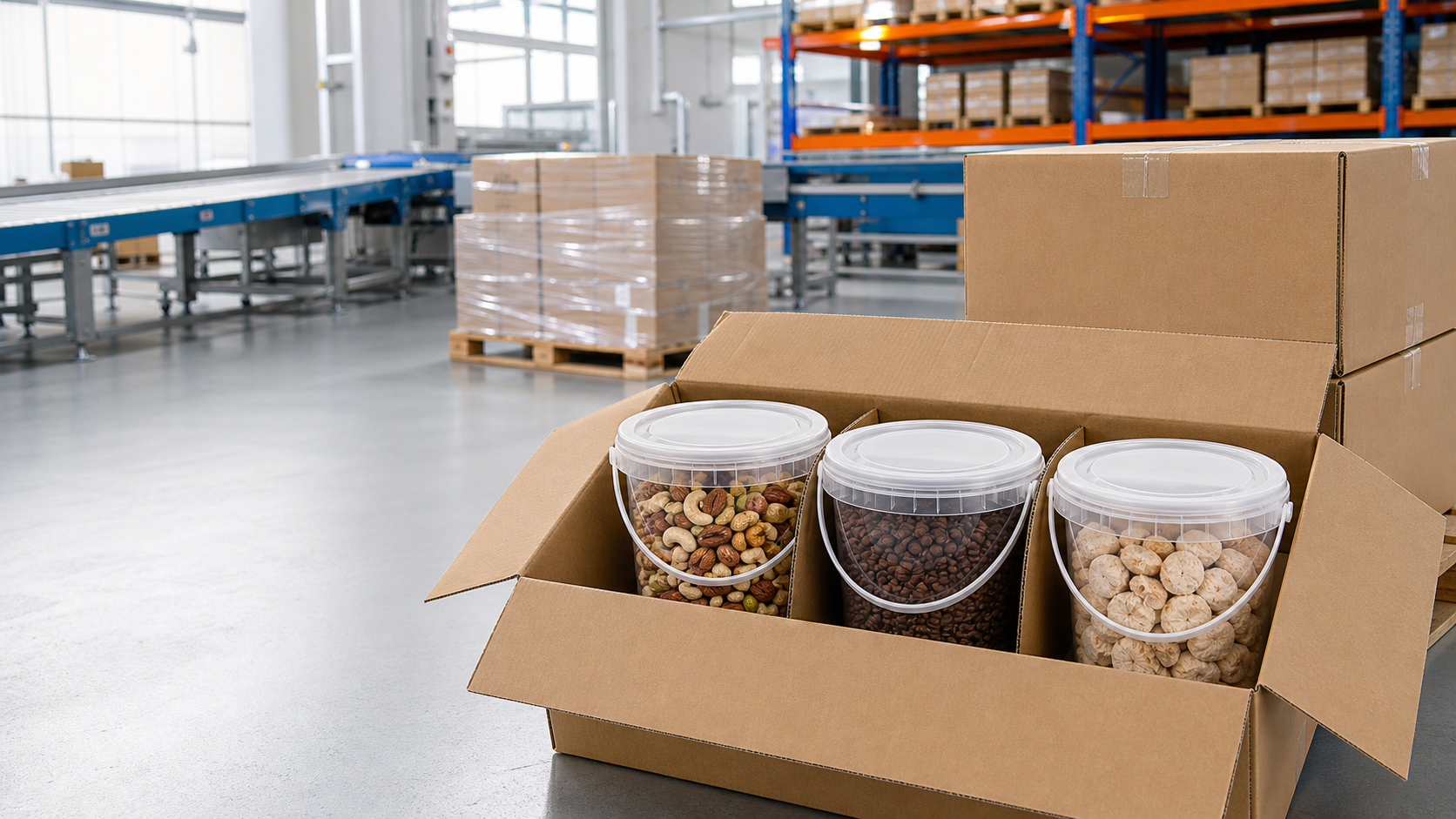
A filled package may move from the production line to a warehouse, into a shipping carton, through pallet handling, vehicle transport, parcel sorting and final delivery. Each step introduces compression, vibration, impact and repeated handling. A container that looks excellent in a studio can behave very differently in a full logistics system.
For nuts, coffee beans, cookies, confectionery, pet treats and other products that can be crushed or fragmented, PP food bucket transport stability deserves attention early in packaging development. The right rigid bucket can provide a useful protective structure, but performance also depends on the lid, fill level, carton, stacking pattern and actual distribution environment.
This guide explains how to evaluate the complete packaging system and how JM Pack can support a more transport-ready PP food bucket project.
Food Packaging Must Perform Beyond the Shelf
Packaging has two connected jobs. It must present the product clearly enough to earn attention, and it must help protect that presentation until the customer opens it.
The distribution journey may include:
- Filling and lid application.
- Carton packing and internal separation.
- Warehouse stacking and pallet movement.
- Loading, unloading and vehicle vibration.
- Courier sorting and last-mile delivery.
- Customer carrying, storage and repeated opening.
If the package loses shape, the lid loosens or the food is heavily crushed, the problem reaches the customer even when the food was correct at the factory. Damage can increase replacement costs, reviews, customer-service work and uncertainty about the brand.
Transport stability therefore belongs in the same conversation as food-contact suitability, sealing, decoration and price.
What Does PP Food Bucket Transport Stability Mean?
Transport stability is not a claim that a bucket is impossible to damage. No package can be assessed independently of its contents and shipping conditions.
In practical terms, a transport-stable package is a system designed to maintain acceptable container, closure and product condition through its intended distribution cycle. It should be evaluated for:
- Bucket deformation under expected compression.
- Lid retention during vibration and handling.
- Product movement and breakage inside the container.
- Fit and movement inside the shipping carton.
- Carton stacking and pallet stability.
- Visual condition when the package reaches the buyer.
The required performance varies. A palletized foodservice shipment follows a different route from an individual e-commerce parcel. A dense ingredient creates different loads from lightweight freeze-dried pieces. The test plan should reflect the real sales channel.
Why Flexible Bags Can Expose Fragile Food to More Compression
Flexible pouches remain useful because they are light and material-efficient. For many products, they are the correct choice. However, the pouch itself provides limited rigid spacing between outside pressure and the food.
When bags are packed tightly in cartons or compressed by surrounding parcels, forces can transfer more directly to nuts, cookies, coffee beans, candy, puffed snacks or freeze-dried pet food. The seal may remain intact while product appearance declines.
A rigid PP bucket creates a more defined outer volume. Its wall can carry part of the external load and maintain space around the contents. This does not eliminate the need for a suitable carton, but it can reduce direct compression on fragile products and help the retail package keep its intended shape.
The choice between a pouch and a bucket should consider product fragility, portion size, reclosability, shelf presentation, distribution method and total delivered cost.
Eight Factors That Determine Transport Performance
1. Bucket Geometry and Structural Consistency
Wall design, rim geometry, base shape and taper all affect how a bucket behaves during stacking and compression. A stable base helps the package sit evenly. A consistent rim helps the lid engage correctly. Ribs and transitions must be designed without creating unnecessary weak areas.
Manufacturing consistency matters as much as the nominal design. Variation in dimensions can change lid fit, carton packing and stack behavior across batches. Buyers should evaluate production samples rather than relying only on capacity and external dimensions.
JM Pack supplies a range of plastic buckets and pails so a project can be matched to product volume, handling and distribution requirements.
2. Lid Fit and Closure Retention
The bucket and lid work as one package. A rigid body cannot compensate for a lid that is not fully seated or is poorly matched to the rim.
Closure evaluation should confirm:
- Correct alignment during application.
- Complete engagement around the rim.
- Suitable opening force for the end user.
- Resistance to loosening during vibration and handling.
- Compatibility with tamper-evident features when required.
Filling-line procedures also matter. Operators or equipment must apply the lid consistently, and closed packages should be checked before cartoning.
3. Product Weight, Density and Fragility
The same bucket can behave differently with two products of equal net weight. Dense coffee beans, lightweight freeze-dried pieces and irregular cookies distribute forces in different ways.
Packaging development should use the actual product or a representative substitute with similar bulk density and fragility. Net weight alone is not enough to predict fill height, center of gravity or internal movement.
4. Fill Level and Headspace
It is tempting to assume that a completely packed bucket prevents movement. For fragile food, overfilling can create another risk. If the contents are compressed tightly against the lid and walls, an external load on the bucket may transfer into the product.
A better target is a compatible bucket size, controlled fill quantity and appropriate headspace. The package should limit excessive movement without crushing the contents before transport begins.
Headspace requirements depend on product shape, settling behavior, gas generation, filling process and handling. Trial filling is the most reliable way to identify a practical level.
5. Carton Fit and Internal Separation
The food bucket is only the primary package. During distribution, the corrugated carton becomes part of the protective system.
An oversized carton can allow buckets to move and collide. A carton that is too tight can apply continuous side pressure. Dividers, pads or other internal components may be useful when bucket contact or movement needs to be controlled.
The carton should be evaluated for:
- Bucket count and orientation.
- Internal clearance and dividers.
- Board strength and closure method.
- Gross weight.
- Stack height and warehouse conditions.
- Parcel or pallet distribution route.
Bucket selection should therefore include a carton-packing study, not just an individual container quotation.
6. Packing Density and Logistics Efficiency
Two buckets with similar unit prices can create different delivered costs. If one format allows 24 units per carton and another allows only 16, the number of cartons, pallet positions, warehouse volume and freight volume may change significantly.
Choosing a bucket that is much larger than the product requires can also increase visible empty space and reduce carton efficiency. The best size balances net content, bulk volume, shelf presentation, safe headspace and shipping configuration.
For compact retail packs, options such as the 1200ml sealable round food-grade container and 2L PP plastic jar with lid provide useful starting points for trial filling and carton calculations.
7. Pallet Pattern and Stack Loads
Cartons that perform well individually can still become unstable in a poor pallet pattern. Overhang, uneven layers, insufficient restraint and high stack loads can distort cartons and transfer pressure to the buckets.
Review the complete pallet configuration, including layer pattern, total height, corner support, stretch wrapping and handling equipment. Warehouses with high humidity or long storage periods may also require additional carton-strength consideration.
8. Transparent Packaging and Pre-Shipment Inspection
Transparent PP buckets provide a practical inspection advantage. Before cartoning, staff can see fill level, obvious product breakage, color consistency and potential contamination or foreign material more directly.
Transparency also lets customers inspect products such as nuts, coffee beans, candy and pet treats without opening the package. For visually appealing foods, the product becomes part of the presentation.
The 10L transparent food-grade PP pail illustrates how visibility and handled transport convenience can be combined for larger packs.
How to Choose the Right Bucket Capacity
Capacity should be based on actual bulk volume rather than a simple conversion from net weight. A 500g product may require very different space depending on whether it is coffee, nuts, powder, cookies or freeze-dried food.
Use this selection sequence:
- Measure the intended net weight of the actual product.
- Trial-fill several candidate bucket sizes.
- Check headspace, settling and product movement.
- Confirm lid application and opening experience.
- Calculate units per carton and gross carton weight.
- Compare pallet and parcel efficiency.
- Test the preferred configuration under realistic handling.
Mid-size formats such as the 4L round food-grade plastic bucket and 5L food-grade round plastic bucket can support family packs, foodservice portions and ingredient applications. The best result still depends on physical testing with the intended contents.
A Practical Transport Simulation Before Mass Production
A basic simulation can reveal issues that are invisible during a simple fill test. It does not replace a formal laboratory protocol when one is required, but it is a valuable development step.
Prepare Representative Samples
Use production-intent buckets, lids, labels and cartons. Fill each bucket to the planned net quantity with the real product. Apply the closure using the intended filling-line method.
Pack the Final Carton Configuration
Use the planned number of buckets, orientation, dividers, pads and carton closure. Record gross weight and internal clearance. Prepare enough cartons to assess stacking, not only one isolated box.
Reproduce Expected Handling
Depending on the channel, evaluate carrying, repeated movement, vibration, stacking and controlled impact. E-commerce parcels may need different handling simulations from palletized wholesale shipments. Use recognized test methods or qualified laboratories when customers, retailers or regulations require them.
Inspect the Complete System
After testing, check:
- Bucket walls and bases for deformation or cracks.
- Lids for lifting, loosening or leakage.
- Handles and attachment points.
- Product breakage, abrasion or settling.
- Bucket movement and carton-divider condition.
- Carton crushing, bulging or puncture.
- Overall appearance for the final customer.
Document the setup and results. If the package changes, repeat the relevant checks rather than assuming the earlier result still applies.
Calculate Total Packaging Cost, Not Only Bucket Price
A small unit-price difference can look important across a large order, but procurement decisions should include the cost of using the package.
Total packaging cost may include:
- Bucket, lid, label and carton costs.
- Filling and lid-application efficiency.
- Units packed per carton and pallet.
- Warehouse and freight volume.
- Packaging scrap and product loss.
- Damage claims, replacements and customer service.
- Brand impact from poor arrival condition.
A cheaper bucket that creates lower carton density or more damage can become the more expensive option. Conversely, the most robust package is not automatically the best if it adds unnecessary material or freight volume. The goal is a validated system appropriate for the product and route.
Food Products That Often Benefit From Rigid Buckets
Nuts and Dried Fruit
Rigid walls can help protect shape, while a reclosable lid supports repeated consumption. Transparent formats can showcase product color and mix quality. Read our dedicated guide to PP plastic buckets for nut packaging for more category-specific considerations.
Coffee Beans and Tea
These products can benefit from a stable branded package that holds its shape in cartons and online photography. Product-specific moisture, oxygen and aroma-barrier requirements must still be evaluated separately.
Cookies, Candy and Puffed Snacks
Fragile pieces need enough internal room to avoid pre-compression, but not so much space that they move excessively. Bucket diameter, fill height and carton orientation should be tested together.
Pet Treats and Freeze-Dried Pet Food
Breakage can reduce perceived value even when nutritional quality is unchanged. Rigid, reclosable packaging can support product presentation and everyday handling for premium pet products.
Bakery and Foodservice Ingredients
Handled buckets can improve carrying and identification in commercial kitchens and production areas. Larger packs need careful review of gross weight, handle load, carton configuration and stacking.
Supplier Capability Is Part of Transport Stability
Packaging performance also depends on repeatable supply. A successful first batch is not enough when a growing brand needs seasonal volume, multiple SKUs and regular replenishment.
Evaluate whether the supplier can support:
- Consistent PP material and molding controls.
- Stable bucket and lid dimensions across batches.
- A useful range of existing molds and capacities.
- Transparent, white and colored options.
- Tamper-evident closure requirements where available.
- Decoration such as in-mold labeling, screen printing and other custom branding.
- Sampling, scale-up and repeat delivery planning.
- Clear quality procedures and issue response.
JM Pack supports food-grade PP packaging projects across nuts, coffee, tea, confectionery, pet food, bakery products and ingredients. Branding can also be integrated into the distribution-ready package; our guide to in-mold labeling for PP food buckets explains the visual and durability considerations.
Explore JM Pack’s broader food packaging solutions when a project requires comparison across container formats.
Frequently Asked Questions
Are PP food buckets unbreakable during shipping?
No. Rigid PP buckets can provide useful structural protection, but performance depends on bucket design, product weight, closure, carton, packing pattern, stack loads and handling conditions. The complete system should be tested.
How much headspace should a food bucket have?
There is no universal percentage. The correct headspace depends on product fragility, bulk density, settling, filling method, shelf-life needs and shipping environment. Trial filling and transport simulation are recommended.
Is a larger bucket safer for fragile food?
Not automatically. Excess space can allow more movement and reduce carton efficiency, while too little space can compress the product. Select the smallest practical size that provides appropriate fill level, headspace and presentation.
Should the bucket and carton be sourced as one project?
They do not have to come from one supplier, but they should be developed as one system. Bucket dimensions, units per carton, dividers, board strength, pallet pattern and distribution route influence one another.
What information does JM Pack need for a recommendation?
Share the product type, net weight, bulk volume, fragility, preferred capacity, annual quantity, filling conditions, sales channel, carton plan, destination market and branding requirements. Physical samples or trial-fill data can improve the recommendation.
Build Transport Stability Into the Packaging Decision
The value of a food package is not limited to holding the product. It must accompany that product through filling, warehousing, cartoning, handling and transport before it reaches the customer.
That is why the best procurement question is not simply, “Which bucket is cheapest?” It is, “Which packaging system can deliver the required protection, carton efficiency, presentation and supply reliability at the best total cost?”
To evaluate capacity, lid style, transparency, decoration and shipping configuration, contact JM Pack with your product and distribution details. We can help identify suitable PP food bucket options for sampling and validation.
2 thoughts on “How Transport-Stable PP Food Buckets Protect Products in Distribution”
So,I like it
That was amazing