
When buyers receive a food packaging bucket sample, one of the first things they often do is squeeze the wall and ask, “How thick is it?”
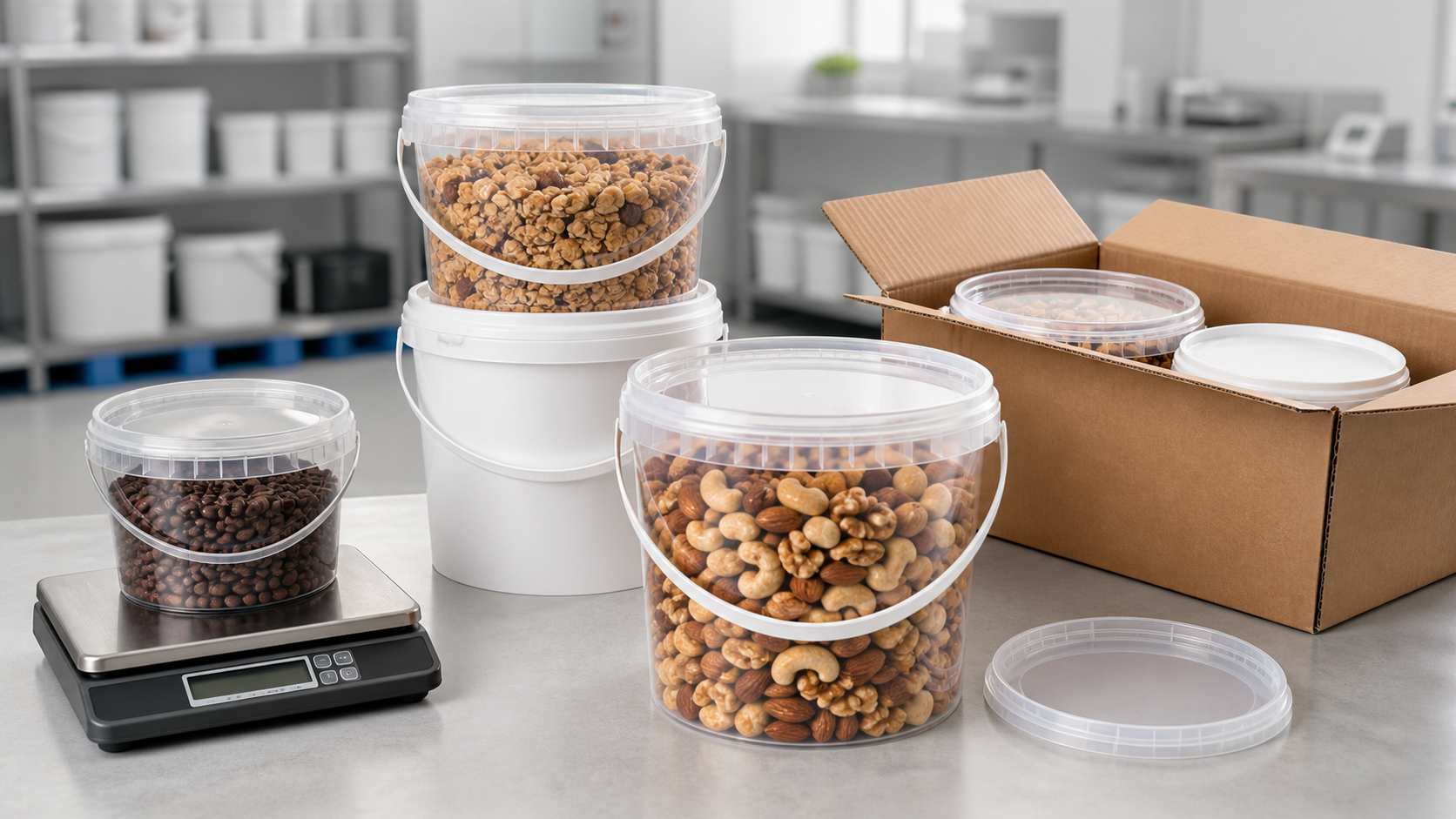
It is an understandable question. A rigid bucket can feel reassuring, and a thicker wall may improve stiffness in some applications. But wall thickness alone cannot tell you whether the package will perform well after filling, closing, stacking, shipping and repeated use.
For food brands, the better question is not simply, “Is this bucket thick enough?” It is, “Is this packaging system suitable for my product, filling process, supply chain and customer?”
This guide explains the details that influence the real user experience of a food packaging bucket and shows how JM Pack helps buyers select food-grade PP buckets by application rather than by a single measurement.
Why Buyers Often Use Thickness as a Quality Shortcut
Thickness is easy to feel and easy to compare. Put two empty plastic buckets on a table and press their walls. The bucket that feels harder may appear stronger, more durable or better made.
That quick comparison can be useful as an initial observation, but it is incomplete. A bucket is not used as an empty object in a sample room. It is filled with nuts, coffee beans, pet treats, candy, ingredients or another food product. It is then closed, lifted, packed, stored, transported, opened and closed again.
The package must work as a coordinated system. Material selection, wall geometry, rim design, base structure, closure fit, sealing performance, capacity and handling all contribute to the final result.
In other words, a food packaging bucket is not judged by the bucket wall alone.
Is a Thicker Food Packaging Bucket Always Better?
Not necessarily.
Adding material can increase rigidity in certain designs, but it can also increase package weight, resin consumption, unit cost and transportation weight. A heavier bucket may create a higher delivered cost without solving the actual problem if the issue is poor lid fit, an unsuitable shape or the wrong capacity.
The goal of good packaging design is not maximum thickness. It is a balanced relationship between material, structure and performance.
The right question is whether the bucket can support the expected load, closure, stacking and handling conditions with an efficient design. A well-designed PP bucket can provide practical strength through the combination of wall profile, rim geometry, base construction and reinforcing features, rather than relying on excess material everywhere.
Five Structural Details That Matter More Than a Simple Thickness Comparison
1. The Bucket Rim and Opening
The rim affects how the lid locates, how force is distributed during closure and how the opening feels during repeated use. A stable rim helps the lid seat consistently and supports a cleaner sealing interface.
For food products, the opening also influences filling speed, emptying, scooping and cleaning. A bucket that feels rigid but has an awkward opening may still create a poor production or consumer experience.
2. The Wall Profile
The shape of the wall affects stiffness, appearance and stackability. Taper, ribs, transitions and local reinforcement can change how the container responds to pressure after filling.
Two buckets made from similar PP material can feel different because their geometry distributes force differently. This is why a filled-product test is more informative than squeezing an empty wall at one point.
3. The Base Structure
The bottom supports the product load and influences stability during storage, stacking and transport. A base that is appropriate for the capacity and product density can help the bucket stand evenly and maintain its shape under normal handling.
For larger foodservice or ingredient formats, the bottom should be evaluated together with carton dimensions, pallet arrangement and the expected stacking pattern.
4. Reinforcing Areas and Handles
Handles and attachment points carry concentrated forces, especially on larger buckets. Their position, connection and comfort matter when a filled package is lifted from a pallet, carried through a store or moved around a commercial kitchen.
A handle is not only a convenience feature. It is part of the load-bearing experience and should be tested with the actual filled weight.
5. The Lid and Bucket Fit
The bucket and lid must be treated as one packaging set. A thick bucket with a lid that is difficult to press on, easy to loosen or uncomfortable to open will not deliver a good user experience.
The lid should close consistently, protect the contents during normal handling and support the intended opening and reclosure cycle. Depending on the format, a tamper-indicating feature may also help users recognize whether the package has been opened for the first time.
Empty-Bucket Testing and Filled-Product Testing Are Different
An empty bucket can reveal some basic information about appearance, dimensions and handling. It cannot fully represent what happens after the package is filled.
Different foods create different loads and occupy different volumes. A lightweight, bulky freeze-dried treat may need more headspace than a dense product. Nuts can create a higher filled weight in the same nominal volume. Coffee beans, tea, candy and bakery ingredients also vary in bulk density, particle size and flow behavior.
That means the same food packaging bucket may perform differently with different products. A more reliable evaluation process is to fill the sample with the intended product at the intended sales quantity, then observe:
- Whether the capacity leaves practical headspace.
- Whether the bucket wall maintains a stable shape.
- Whether the lid closes without excessive force.
- Whether the filled package can be lifted comfortably.
- Whether the product is easy to remove without damaging it.
- Whether the package can be closed again after use.
For a new project, the best sample is not just a sample bucket. It is a sample bucket tested with the real product.
Lid Fit and Sealing Directly Affect Everyday Experience
Customers interact with the lid every time they open a package. The experience includes locating the opening point, breaking any tamper indication, removing the lid, taking out the product and closing the bucket again.
For nuts, coffee, tea, pet treats and other products that may be used over several occasions, reclosure is especially important. If the lid is difficult to close, if it becomes loose after repeated use or if the opening feature is unclear, the package may feel low quality even when the bucket wall is very rigid.
When evaluating a food-grade PP bucket, check the complete closure system:
- Does the lid align with the rim?
- Is the initial closure consistent from sample to sample?
- Is the first opening clear to the user?
- Does any tamper-indicating feature function as intended?
- Can the lid be replaced securely after taking out a portion?
- Does the closure remain practical after repeated opening and closing?
These details often have a greater effect on customer satisfaction than a small difference in wall thickness.
Transport Performance Cannot Be Predicted by Hand Pressure Alone
Pressing the wall with a finger is a quick check, but food packaging may experience many different forces before it reaches the end user:
- Filling and closing at the production site.
- Cartoning and palletizing.
- Warehouse stacking.
- Forklift or manual handling.
- Road, sea or air transportation.
- Parcel sorting or last-mile delivery.
- Shelf handling and consumer use.
For a project with meaningful transport requirements, consider filled-carton testing, stacking checks and a practical simulation of the intended distribution route. The test should reflect the actual product weight, carton configuration and storage conditions.
This approach provides more useful information than deciding that one empty bucket “feels thicker” than another.
Different Foods Need Different Packaging Priorities
There is no universal food packaging bucket that is equally suitable for every food product.
Nuts and Dried Fruit
Nuts may create a relatively high filled weight, while the product’s appearance is also important to the brand. The package should balance rigid protection, capacity, visibility, closure performance and transport stability. Our guide to PP plastic buckets for nut packaging covers the specific reasons many nut brands choose rigid PP formats.
Freeze-Dried Pet Treats
Freeze-dried products can be light and bulky. Capacity, headspace and product presentation may matter more than simply increasing wall thickness. The package should also make repeated opening and portioning convenient for pet owners.
Coffee Beans and Tea
Coffee and tea packaging often experiences repeated opening. Lid fit, reclosure and the visual presentation of the contents are important. Depending on the product and target market, additional barrier or inner-sealing requirements may need to be reviewed separately.
Candy, Snacks and Bakery Ingredients
These products may benefit from clear product visibility, easy identification and a practical opening. Larger formats used by bakeries, restaurants and foodservice operations also need to work with staff handling, storage and carton logistics.
Capacity Should Be Matched to Product Density, Not Just Net Weight
One of the most common selection mistakes is assuming that a certain net weight always requires the same bucket capacity.
One kilogram of nuts, coffee beans, candy or freeze-dried food may occupy a different volume because the products have different bulk densities and shapes. The required capacity also depends on headspace, filling tolerance, product settling and the desired visual presentation.
JM Pack offers multiple formats so buyers can compare the package against the real product:
- The 1200ml sealable round food-grade plastic container for compact retail packs, sampling and smaller portions.
- The 2L PP plastic jar with lid for household, specialty food and mid-size applications.
- The 4L round food-grade plastic bucket for restaurant, bakery and foodservice formats.
- The 5L food-grade round plastic bucket with lid for family-size, bulk retail and frequent-use products.
- The 10L transparent food-grade PP pail for larger ingredient and commercial packaging needs.
The best capacity is confirmed by sample filling, not by net weight alone.
A Practical Six-Step Test for a Food Packaging Bucket
When a sample arrives, use it in a way that resembles the real project.
1. Fill
Add the actual product at the intended sale quantity. Check fill level, headspace, product settling and whether the bucket remains stable.
2. Close
Install the lid using the expected production or consumer method. Check alignment, closure force, sealing contact and any tamper-indicating feature.
3. Lift
If the package has a handle, lift the filled bucket from different positions. Observe comfort, balance and the connection between the handle and bucket body.
4. Open
Simulate the first consumer opening. Confirm that the opening area is clear and that the lid can be removed without damaging the package or spilling the contents.
5. Reuse
Open, take out a portion and close the bucket again several times. This reveals more about everyday convenience than a single showroom demonstration.
6. Ship
Pack the sample according to the intended carton and pallet arrangement. Where appropriate, perform stacking and basic transport simulation to identify risks before mass production.
This test sequence turns the question from “How does an empty bucket feel?” into “How does my product perform in this packaging system?”
Why Product Samples Should Be Tested Before a First Bulk Order
Dimensions and nominal capacity cannot show every practical issue. A product may fit inside a bucket but still require too little headspace, make the lid difficult to close or create an uncomfortable filled weight.
Samples allow the buyer and supplier to check the package with the real food product before committing to a larger quantity. They can also help confirm the correct bucket color, transparency, handle, lid style and decoration method.
For brands considering custom decoration, sample approval is especially useful. JM Pack can review options such as logo printing, screen printing, heat transfer and in-mold labeling according to the artwork, order plan and desired finish.
What to Look for in a Food Packaging Bucket Supplier
The supplier should help match the package to the application instead of selling by a single thickness number. Useful questions include:
- Is the PP material suitable for the intended food-contact application and destination market?
- How are bucket dimensions and lid fit controlled?
- Can the supplier provide samples for filled-product testing?
- Are transparent, white or colored PP options available?
- Can the supplier support logo customization and decoration development?
- Is there a clear process for confirming tooling, minimum order quantity and lead time?
- Can the supplier scale from a sample or pilot order to repeat production?
JM Pack supplies food-grade PP buckets and pails for nuts, snacks, pet food, coffee, tea, bakery ingredients, foodservice products and other packaged foods. Buyers can review the plastic buckets and pails category or explore our food packaging solutions before discussing a specific project.
How JM Pack Helps With Food Bucket Selection
JM Pack focuses on the complete package: container format, lid fit, capacity, handling, product presentation and customization. Depending on the project, options may include transparent or colored PP, different capacities, handles, tamper-indicating closure features and branded decoration.
Instead of starting with “How thick is the bucket?”, a buyer can provide three practical inputs:
- Product type.
- Net content or target fill quantity.
- Intended usage and distribution conditions.
With those details, the package can be narrowed down for sample filling and performance review. This creates a more reliable path to a food packaging bucket that works in production, logistics and everyday use.
Conclusion: The Right Food Packaging Bucket Is the One That Fits the Product
A food packaging bucket should not be judged by the word “thick” alone. Thickness may be one data point, but it does not replace a complete evaluation of material, structure, rim, base, lid, seal, capacity, filled weight and transport conditions.
The most practical buying decision is to test the product and package together. Fill the bucket, close it, lift it, open it, use it repeatedly and simulate its intended distribution. That is how a brand discovers whether a package is genuinely suitable.
For food brands seeking a reliable PP bucket with the right capacity, closure and customization options, contact JM Pack with your product type, fill quantity and application details.